Is EAGLE-3 Speculative Decoding Lossless?
EAGLE-3 (NeurIPS 2025) is the current gold standard for speculative decoding, with large speedups in SGLang and vLLM. As a brief summary, EAGLE-3's draft model fuses low, middle, and high-level features from the target model, and implements a training-time test technique to simulate multi-step generation during training.
The other day, as I was looking through their codebase, I stumbled upon something a little strange.
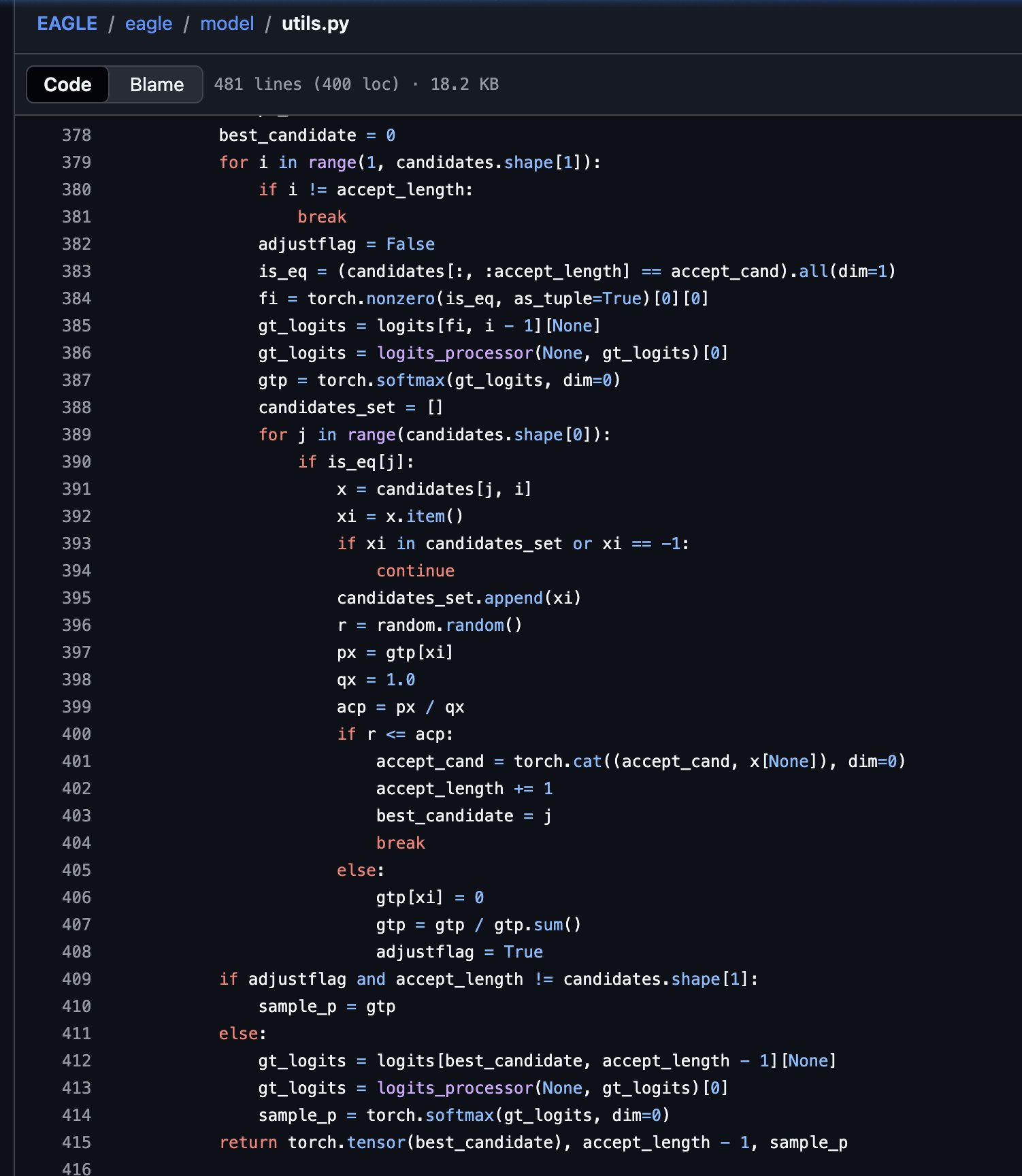
This is their non-greedy implementation. They set \(q(x)=1\) and zero out rejected tokens in the non-greedy path, which skips the residual distribution step needed for a lossless match to \(p(x)\).
The lossless rule in speculative decoding
For non-greedy SD, when a draft proposes a token \(x\), the accept-reject rule is:
If the proposal is rejected, the replacement token must be sampled from the residual distribution:
This residual can easily be derived by multiplying the acceptance probability by \(q(x)\), then subtracting this result from the target distribution \(p(x)\). If the reader is interested, please check out this paper.
In the current EAGLE-3 implementation, the non-greedy branch does not compute \(q(x)\) at all. Instead, it sets \(q(x) = 1\), assuming one-hot encoding and only uses the target distribution \(p(x)\) after candidate masking. So \(q(x)\) is treated as a constant, and acceptance uses \(p(x)\) directly.
This is actually lossless! This code uses \(acp = p(x)\) (since it assumes \(q(x)=1\)) and recovers by sampling from \(p\) excluding the rejected token.
In code, "resampling from a distribution excluding \(x\)" is exactly what this does:
gtp[xi] = 0
gtp = gtp / gtp.sum()
This creates the conditional distribution \(P(k \mid k \ne x)\). When the code later calls torch.multinomial(gtp, 1), it draws from that adjusted distribution.
The probability of outputting token \(k\) under this implementation is:
Here \(j\) is the rejected draft token (\(j \ne k\)). The \((1-p(j))\) terms cancel, so each summand becomes \(q(j)p(k)\).